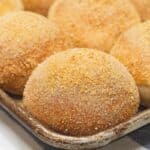
Pandesal
Filipino sweet bread rolls that are soft and fluffy with a slightly crusty exterior.
Servings 20 rolls
Calories 135kcal
Cost $3-$5
Equipment
- Stand mixer with a dough hook attachment (optional)
- Baking Sheet
Ingredients
- 2¼ teaspoons active dry yeast (1 standard packet, 0.25 oz or 7 g) sub: instant yeast (see note)
- 2 tablespoons sugar
- 1 cup warm water
- 3½ cups bread flour sub: all-purpose flour (see note)
- 1 teaspoon kosher salt sub: about ½ teaspoon table salt
- 1 egg at room temperature
- ½ cup condensed milk at room temperature (see note)
- 2 tablespoons neutral oil or melted butter
- ½ cup fine breadcrumbs (see note)
Instructions
- Activate the yeast (only if using active dry yeast): In a medium bowl, combine 2¼ teaspoons active dry yeast, 2 tablespoons sugar, and 1 cup warm water. Stir and let sit for 5-10 minutes until foamy. (Skip if using instant yeast.)
- Dry ingredients: In a large bowl or stand mixer, whisk together 3½ cups bread flour and 1 teaspoon kosher salt (or ½ teaspoon table salt). If using instant yeast, add it now.
- Wet ingredients: Add 1 egg, ½ cup condensed milk, and 2 tablespoons neutral oil to the yeast mixture. Mix until smooth. If using instant yeast, add 1 cup warm water and 2 tablespoon sugar here.
- Combine dry and wet Ingredients: Pour the wet ingredients into the flour mixture. Mix until a sticky dough forms.
- Knead the dough: If using a stand mixer, knead on medium speed for 12-15 minutes. The dough will start sticky but will eventually form a smooth, stretchy ball. When it pulls away from the sides of the bowl, it's ready.If kneading by hand, place the dough on a floured surface and knead for 20-25 minutes until smooth and stretchy. Add a little flour if the dough gets too sticky.
- The windowpane test: Take a small piece of dough and gently stretch it. If it stretches without tearing and you can see light through it, the dough is ready.If it tears, knead the dough more. If it’s tough and hard to stretch, it’s over-kneaded. Let it rest for 30 minutes to relax and make shaping easier.
- Proof the dough (First rise): Form the dough into a ball and place it in a bowl lightly coated with oil so it doesn't stick. Cover with a towel or plastic wrap and set it in a warm, draft-free spot. Let it rise for 1-2 hours, or until it doubles in size.
- Shape the pandesal: Gently press down the dough to release air. Divide the dough in half and roll each into a long, even log shape. Cut each log into 10 equal pieces. Shape each piece into a smooth ball or football shape, then roll in breadcrumbs to coat.
- Proof the dough (Second rise): Place the rolls on a parchment-lined baking sheet, leaving space between each. Cover them and let them rise until they’re puffy, about 30 to 45 minutes.
- Bake: Preheat your oven to 400°F (205°C). Once it’s heated, bake the Pandesal for 5 minutes. Then, lower the temperature to 350°F (175°C) and bake for another 12-14 minutes, or until golden brown.
Notes
- Bread Flour: This flour makes the bread chewy and stretchy. You can use all-purpose flour, but there will be a slight difference.
- Active Dry Yeast: Yeast helps the dough rise. This type needs to be dissolved in warm water with sugar to activate. You can also use the same amount of instant yeast and mix it directly into the dry ingredients since it doesn't need activation. Check the expiration date to make sure it's still good.
- Condensed Milk: Adds sweetness and helps create a soft bread with a golden crust. If you don't have it, replace the 1 cup of water in the recipe with 1 cup of regular milk (like whole or evaporated milk) and add 6 extra tablespoons of sugar.
- Breadcrumbs: Use fine, plain breadcrumbs for coating.
- Refrigerate before the first rise: Once the dough is properly kneaded (Step 6), cover it with plastic wrap and refrigerate for a few hours or overnight. When ready to bake, let it rise at room temperature until doubled in size, then continue with the recipe.
- Refrigerate after shaping: Once shaped and coated with breadcrumbs (Step 8), cover the rolls with plastic wrap and refrigerate for a few hours or overnight. When ready to bake, let them rise at room temperature until puffy, then bake.
- Freeze afte shaping: Shape the dough into individual pieces without adding breadcrumbs (Step 8), freeze on a tray until solid, then store in a freezer bag. When ready to bake, coat with breadcrumbs, let them rise, and bake as usual.
Nutrition
Calories: 135kcal | Carbohydrates: 23g | Protein: 4g | Fat: 3g | Saturated Fat: 1g | Polyunsaturated Fat: 1g | Monounsaturated Fat: 1g | Trans Fat: 0.01g | Cholesterol: 11mg | Sodium: 149mg | Potassium: 62mg | Fiber: 1g | Sugar: 6g | Vitamin A: 33IU | Vitamin C: 0.2mg | Calcium: 31mg | Iron: 0.4mg