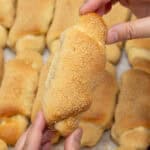
Spanish Bread
Soft Filipino bread rolls filled with a sweet, buttery breadcrumb filling.
Servings 16 rolls
Calories 280kcal
Cost $4-$6
Equipment
- Stand mixer with a dough hook (optional)
- Measuring cups and spoons (or kitchen scale)
- Dough scraper or knife
- Rolling Pin (optional)
- Baking Sheet
Ingredients
For the dough
- 2 teaspoons active dry yeast or instant yeast
- 2 tablespoons sugar
- 1 cup warm water
- 3¼ cups bread flour
- 1 teaspoon kosher salt (or about ½ teaspoon table salt)
- 1 egg at room temperature
- ½ cup condensed milk
- 2 tablespoons neutral oil or melted butter
- ½ cup fine, plain breadcrumbs for coating
For the filling
- ½ cup salted or unsalted butter softened
- ¾ cup light or dark brown sugar
- 1 cup fine, plain breadcrumbs
- 1 teaspoon vanilla extract optional
- Pinch of salt (if using unsalted butter)
Instructions
- Activate the yeast: Combine the active dry yeast, sugar, and warm water. Let it sit for 5 to 10 minutes, until foamy. If using instant yeast, skip this step and add it to the flour.
- Mix the dry ingredients: Whisk together the bread flour and salt. If using instant yeast, add it here.
- Mix the wet ingredients: Into the yeast mixture, add the egg, condensed milk, and oil. Mix until smooth. If using instant yeast, combine the egg, condensed milk, oil, water, and sugar in a separate bowl.
- Make the dough: Pour the wet ingredients into the dry ingredients. Mix until a sticky dough forms.
- Knead: Knead with a dough hook for 12 to 15 minutes or by hand for 20 to 25 minutes. The dough should become smooth and stretchy and come together into a soft ball.
- Let it rise: Place the dough in a lightly greased bowl and cover it. Let it rise in a warm place for 1 to 2 hours, or until doubled in size.
- Make the filling: Mix the softened butter, brown sugar, breadcrumbs, vanilla, and a pinch of salt (if using unsalted butter).
- Divide and fill: Divide the dough into 16 pieces. Flatten each piece into a 6-by-3-inch oval. Add about 2 tablespoons of filling, leaving a small border around the edges.
- Shape and coat: Roll each piece into a log and pinch the seam closed. Roll it in the breadcrumbs and place it seam-side down on a parchment-lined baking sheet.
- Let them rise: Cover and let the rolls rise for 30 to 45 minutes, or until puffy.
- Bake: Bake at 400°F (205°C) for 5 minutes. Lower the temperature to 350°F (175°C) and bake for another 13 to 15 minutes, or until lightly golden.
- Let the rolls cool for a few minutes. Serve warm or at room temperature.
Notes
- Bread flour: Makes the rolls soft and chewy. All-purpose flour will work, but the rolls may be less chewy.
- Yeast: Activate active dry yeast in the warm water and sugar. Add instant yeast directly to the flour. Use the same amount.
- Condensed milk: If you do not have it, leave it out, replace the water with 1 cup whole or evaporated milk, and add 6 tablespoons sugar.
- Breadcrumbs: Use fine, plain breadcrumbs for the filling and coating.
Nutrition
Calories: 280kcal | Carbohydrates: 43g | Protein: 6g | Fat: 10g | Saturated Fat: 5g | Polyunsaturated Fat: 1g | Monounsaturated Fat: 3g | Trans Fat: 0.2g | Cholesterol: 29mg | Sodium: 294mg | Potassium: 104mg | Fiber: 1g | Sugar: 17g | Vitamin A: 218IU | Vitamin C: 0.3mg | Calcium: 62mg | Iron: 1mg