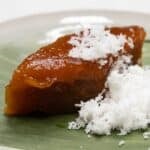
Traditional Kutsinta Recipe (Steamed in a Pan)
This kutsinta recipe has two layers with slightly different textures — a firmer chewy bottom layer and a softer top layer.
Servings 16
Calories 152kcal
Cost $4-$6
Equipment
- Steamer
- 8-inch round pan
- Mixing bowls
- Whisk
- Strainer
Ingredients
Bottom Layer
- 1 cup all-purpose flour
- ⅓ cup tapioca flour cassava starch
- 1 cup dark brown sugar
- 2 cups lukewarm water
- 1 teaspoon lye water
- 1 teaspoon annatto powder
- ½ teaspoon pandan extract or 1 teaspoon vanilla optional
Top Layer
- 1 cup glutinous rice flour
- ½ cup brown sugar
- 1 cup water
- ½ teaspoon lye water
- 1 teaspoon annatto powder
- ¼ teaspoon pandan extract or ½ teaspoon vanilla optional
To Serve
- Fresh grated coconut
Instructions
- Prepare the pan and steamer: Bring water to a boil in a steamer. I used a large pot with a rack and only needed about 1 inch of water. Just keep the water below the rack and add more if needed.Grease an 8-inch round pan well. You can line the bottom with banana leaf or parchment, then grease the liner again.
- Make the bottom layer: In a bowl, combine 1 cup all-purpose flour, ⅓ cup tapioca flour, 1 cup brown sugar, 2 cups lukewarm water, 1 teaspoon annatto powder, 1 teaspoon lye water, and ½ teaspoon pandan extract (optional).Whisk until smooth.
- Strain: Strain the batter to remove lumps, then pour into the prepared pan.
- Steam the bottom layer: Steam over medium-low to medium heat for about 15 minutes, until the surface looks mostly set but the layer is not fully cooked.
- Make the top layer: In another bowl, combine 1 cup glutinous rice flour, ½ cup brown sugar, 1 cup water, 1 teaspoon annatto powder, ½ teaspoon lye water, and ¼ teaspoon pandan flavor (optional).Whisk until smooth.
- Strain the batter: Strain the mixture to remove lumps.
- Add the top layer: Once the bottom layer is mostly set, gently pour the second batter over it. Pour slowly around the sides of the pan first.
- Steam until cooked: Steam for about 30 minutes, or until the top is set and the center no longer jiggles.
- Cool and serve: Let the kutsinta cool completely before slicing. Serve with fresh grated coconut.
Notes
- All-purpose flour: Helps the bottom layer hold its shape so it slices cleanly.
- Tapioca flour (cassava starch): Gives kutsinta its chewy texture. Too much can make it dense or rubbery.
- Glutinous rice flour (sweet rice flour): Used for the top layer to make it softer and slightly sticky.
- Annatto (achuete): Gives kutsinta its orange color and no flavor. Annatto powder mixes in easily. If using seeds, soak them in hot water and use the colored water.
- Brown sugar: I like to mix dark and light brown sugar for a color that’s just right. You can use either one—dark will make the kutsinta darker, while light will make it lighter. You can also use panutsa if you have it.
- Pandan extract or flavor (optional): Adds a light pandan taste. Use clear extract, not the bright green pandan flavoring which will change the color. Vanilla works too, or skip it.
- Grated coconut: Served on top for contrast. Fresh or frozen grated coconut works best. Avoid sweetened shredded coconut since it’s sweeter and drier.
- Strain the batter: Removes lumps for a smoother texture.
- Use lukewarm water: Helps the ingredients dissolve faster and makes mixing easier.
- Do not overcook the first layer: The surface should look set, but the inside should still be soft so the second layer sticks.
- Pour the second layer slowly: Start around the sides of the pan, then toward the center to avoid breaking the first layer.
- Steam over moderate heat: Heat that’s too high can cause bubbling or uneven cooking.
- Check for doneness: The top should look set with no more liquid on top. The center should not jiggle.
- Cool before slicing: Let it cool completely so it can set properly.
- Room temperature: Keep covered for up to 1 day.
- Refrigerator: Store in an airtight container for up to 3 days.
- Grated coconut: Fresh grated coconut should be kept in the refrigerator. Add it only when ready to serve so it stays fresh.
Nutrition
Calories: 152kcal | Carbohydrates: 36g | Protein: 1g | Fat: 0.2g | Saturated Fat: 0.1g | Polyunsaturated Fat: 0.1g | Monounsaturated Fat: 0.1g | Sodium: 7mg | Potassium: 44mg | Fiber: 0.5g | Sugar: 20g | Calcium: 20mg | Iron: 1mg